

Car Insurance Market Growth, USD 2,150 Billion in 2025 to USD 3,710 Billion by 2035 at 5.6% CAGR
car insurance market
Car Insurance Market Size, Share and Research Report By Coverage Type (Bodily Injury Liability, Property Damage Liability, Collision, Comprehensive)
The Car Insurance Market is expanding steadily due to rising vehicle ownership, digital policy management, and increasing demand for comprehensive coverage solutions.”
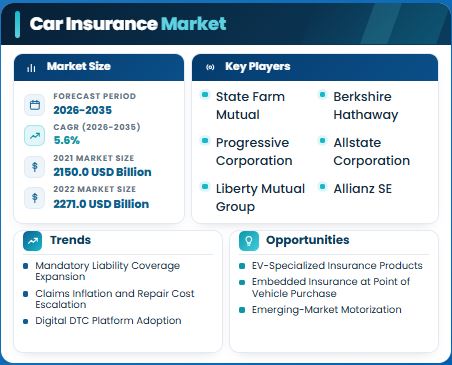
BEIJING, BEIJING, CHINA, July 1, 2026 /EINPresswire.com/ -- The Global car insurance market reached an estimated USD 2,150 billion in 2025 and is projected to grow from USD 2,271 billion in 2026 to approximately USD 3,710 billion by 2035, registering a compound annual growth rate of 5.6% during the forecast period. — Market Research Future (MRFR)
Two major catalysts are accelerating this trajectory: the mandatory expansion of statutory liability coverage requirements across key economies with at least nine U.S. states tightening minimum coverage limits between 2023 and 2025 and India’s Motor Vehicles Amendment Rules raising third-party liability premium floors by 22% and the sweeping digital transformation reshaping how policies are priced, distributed, and serviced.
With digital adoption now influencing more than 52% of all policy purchases globally, and telematics-enabled policies accounting for 18% of new sign-ups, insurers face mounting pressure to modernize their distribution and underwriting infrastructure or risk competitive disadvantage.
Legacy broker-dependent distribution models are rapidly giving way to direct-to-consumer platforms capable of underwriting and binding coverage within minutes. Insurers collectively invested an estimated USD 18 billion in claims automation and digital underwriting infrastructure between 2022 and 2024.
Simultaneously, climate-driven insured losses which surpassed USD 140 billion globally in 2024 are hardening rates and encouraging parametric product innovation. The rise of battery electric vehicles, with BEV insurance projected to expand at a 13.5% CAGR through 2035, and usage-based insurance telematics platforms growing at 17.46% CAGR over the same period, are adding entirely new actuarial dimensions and revenue streams to the global car insurance market.
Get Full PDF Sample Copy of Report: (Including Full TOC, List of Tables & Figures, Chart) @
https://www.marketresearchfuture.com/sample_request/22576
➤ How Significant Is the Car Insurance Market’s Growth?
The car insurance market has demonstrated consistent and robust expansion driven by multiple structural tailwinds that are largely inelastic to economic cycles. Mandatory motor insurance regulations create a captive demand base that grows in direct proportion to global vehicle parc expansion now surpassing 1.48 billion registered vehicles worldwide.
Rising vehicle ownership in emerging economies, growing road accident awareness, and escalating vehicle repair costs with the average U.S. auto physical-damage claim reaching USD 4,800 in 2024, a 31% rise from 2020 levels are all independently sufficient to sustain premium volume growth through 2035.
The personal segment holds the largest market share, with new vehicle insurance capturing approximately 62.7% of premiums in 2025 as rising new car sales, advanced safety features, and telematics integration make new-vehicle policies the most dynamic and innovation-rich segment.
Third-party liability coverage leads by coverage type, accounting for approximately 40.2% of global revenue in 2025, while own-damage and comprehensive coverage represent the largest premium pool in mature markets where average repair costs and vehicle values justify broader protection. Own-damage coverage captured 62.2% of market share in high-income markets in 2025.
➤ What Does the Future Hold for the Car Insurance Market?
Telematics and usage-based insurance stand at the forefront of the car insurance market’s next growth phase. The global automotive usage-based insurance market, valued at USD 76.90 billion in 2025, is projected to reach USD 384.44 billion by 2035 at a CAGR of 17.46%, driven by telematics adoption, rising demand for personalized insurance solutions, and expanding connected vehicle ecosystems.
Approximately 62% of U.S. insurers now offer telematics-based policies, and around 56% of drivers express willingness to adopt usage-based insurance models in exchange for premium discounts tied to safer driving behavior. Vehicle-to-everything (V2X) communication and AI-powered behavioral analytics are enabling hyper-personalized pricing that rewards individual driving patterns, route risk profiles, and real-time incident avoidance fundamentally reshaping actuarial risk models that have remained static for decades.
Electric vehicle insurance represents the single most disruptive growth vector reshaping the car insurance market’s future. The global EV insurance market, valued at approximately USD 85.39 billion in 2025, is projected to reach USD 421.10 billion by 2035 at a CAGR of 17.30%. With nearly 17 million electric cars sold globally in 2024 and EV adoption in Asia exceeding 50% of global EV sales, insurers must develop entirely new actuarial models encompassing battery degradation risk, specialized repair cost structures, and software-defined vehicle liability frameworks.
EV battery replacement costs, limited certified repair networks, and the absence of extensive historical claims data are creating both underwriting challenges and significant premium differentiation opportunities.
Embedded insurance distribution integrating coverage directly into automotive manufacturer purchase workflows, ride-hailing platforms, and digital lending ecosystems is advancing at a 9.6% CAGR through 2035, progressively disintermediating traditional broker and agent channels. Insurtech platforms like Lemonade, which expanded AI-driven car insurance to Indiana in July 2025, and fully digital brands like Zen Insurance in England the first digital-native car insurer powered by Verisk Ignite’s cloud platform, launched in May 2026 exemplify the structural distribution shift underway.
➤ Who Are the Key Players in the Car Insurance Market?
The car insurance landscape is characterized by a mix of incumbent multinational insurers with century-long market positions, digital-native insurtech challengers, and OEM-affiliated insurance subsidiaries. Key participants shaping the competitive dynamics include:
★State Farm Mutual — the largest U.S. personal auto insurer by market share, offering personal auto insurance, rental reimbursement, roadside assistance, and Drive Safe & Save telematics programs.
★Berkshire Hathaway (GEICO) — a direct-to-consumer pioneer leveraging cost-efficient distribution and AI-driven underwriting to maintain highly competitive premium pricing across the U.S. personal auto market.
★Progressive Corporation — the industry leader in usage-based insurance innovation through its Snapshot telematics program, offering real-time driving behavior monitoring and personalized premium discounts to policyholders.
★Allstate Corporation — providing auto insurance with digital claim management, collision coverage, roadside assistance, and the Drivewise telematics platform integrating mobile app-based driving behavior analytics.
★Liberty Mutual Group — offering comprehensive personal and commercial auto coverage globally, with growing emphasis on digital distribution, parametric product innovation, and climate-resilient underwriting frameworks.
★Allianz SE — a global insurance leader providing comprehensive motor insurance, electric vehicle insurance, fleet insurance, and connected car insurance across European and Asia-Pacific markets.
★AXA Group — delivering motor insurance innovation across Europe and Asia with digital-first claims processing, AI-powered fraud detection, and telematics-integrated pay-per-kilometer products.
★Zurich Insurance Group — offering commercial and personal auto insurance solutions with particular strength in fleet management, embedded insurance partnerships with automotive OEMs, and parametric climate risk coverage.
Competition in the market is intensifying as incumbent carriers race to embed generative AI into underwriting, claims adjudication, and fraud detection workflows. Ping An Insurance, People’s Insurance Company of China, and China Pacific Insurance dominate Asia-Pacific market share, collectively insuring more than 300 million registered vehicles in China alone. Strategic alliances between insurers and automotive OEMs — enabling embedded, factory-fitted telematics and at-purchase policy binding — are emerging as the defining competitive differentiator for the decade ahead.
➤ What Are the Emerging Trends in the Car Insurance Market?
Several transformational trends are redefining how the car insurance market evolves through 2035:
Telematics & Usage-Based Insurance (UBI) Expansion: OBD-II dongles, smartphone app-based monitoring, and OEM-integrated telematics are enabling insurers to price risk at the individual driver level, replacing demographic proxies with real-time behavioral data. Fleet telematics adoption exceeds 48% globally, with documented claims frequency reductions of 14% among telematics-enrolled fleets.
Electric Vehicle Insurance Innovation: Specialized EV insurance products covering battery degradation, software update liability, charging infrastructure damage, and range anxiety incidents are emerging as a distinct product category. DuPont’s October 2024 recognition by Samsung for pioneering EV-enabling materials underscores the cross-sector collaboration required to build actuarially sound EV risk models.
AI-Powered Claims Automation & Fraud Detection: Computer vision platforms that automatically assess vehicle damage from smartphone photos, NLP-driven first-notice-of-loss processing, and predictive fraud scoring models are reducing claims cycle times from weeks to hours and cutting combined loss ratios by measurable margins at leading carriers.
Embedded & Affinity Distribution Growth: Auto dealerships, OEM brands, ride-hailing platforms, and digital lending ecosystems are becoming primary insurance distribution points, capturing policyholders at the moment of vehicle acquisition before traditional broker engagement can occur. This channel is advancing at a 9.6% CAGR through 2035.
Climate-Driven Rate Hardening & Parametric Products: With climate insured losses exceeding USD 140 billion in 2024 and California insurers reevaluating pricing models following new 2025 state regulatory shifts in wildfire-prone regions, parametric index-based auto policies that trigger automatically on defined weather events are emerging as a complement to traditional indemnity coverage.
Autonomous Vehicle & ADAS Liability Rebalancing: The proliferation of ADAS-equipped vehicles — whose calibrated sensor replacements are driving the 31% surge in average physical-damage claim costs since 2020 — is forcing insurers and regulators to redefine liability attribution between human drivers and automated systems, with product liability gradually absorbing a greater share of accident-related risk.
Get access to the full description of the report @
https://www.marketresearchfuture.com/reports/car-insurance-market-22576
➤ How Is the Car Insurance Market Segmented?
The car insurance market report provides a comprehensive segmentation framework:
By Coverage Type: Bodily Injury Liability, Property Damage Liability, Collision, Comprehensive, Uninsured Motorist, Ancillary & Add-On Coverages
By Distribution Channel: Independent Agents, Captive Agents, Online Platforms, Direct Insurers, Embedded & Affinity Partnerships
By Vehicle Type: Passenger Cars, Commercial Vehicles (Trucks, Vans, Buses), Motorcycles, Recreational Vehicles (RVs)
By Powertrain: Internal Combustion Engine Vehicles, Battery Electric Vehicles, Hybrid Electric Vehicles
By Application: Personal Vehicle, Commercial Vehicle
By Policy Type: Annual Policies, Short-Term & On-Demand Policies, Pay-Per-Mile Policies, Usage-Based Insurance (UBI)
➤ What Are the Regional Insights from the Car Insurance Market?
North America - commands approximately 38% of global car insurance market premiums in 2025, underpinned by the world’s highest average policy prices, mandatory liability requirements that have been progressively tightened across multiple U.S. states, and the world’s largest concentration of ADAS-equipped vehicles driving claims cost inflation.
The U.S. vehicle insurance market alone was valued at USD 232.96 billion in 2025 and is projected to reach USD 461.70 billion by 2035, growing at a CAGR of 7.08%. Digital direct-to-consumer platforms, insurtech innovation, and the Progressive Snapshot model of telematics-based pricing have made North America the global proving ground for next-generation car insurance distribution and underwriting.
Asia-Pacific - is the fastest-growing region, projected to expand at approximately 7.1% CAGR through 2035. China alone insures more than 300 million registered vehicles, commanding over 50% of regional market activity, while India contributes significantly with more than 120 million insured vehicles and policy digitalization increasing more than 20% annually.
EV adoption in Asia exceeds 50% of global EV sales, creating acute demand for specialized insurance products and novel actuarial frameworks. Telematics adoption is growing rapidly across China, Japan, South Korea, and Australia, already reaching 16% of new policies. Motor insurance accounts for nearly 38% of general-insurance business across many Asia-Pacific markets.
Europe - holds the second-largest market share at approximately 27% of 2025 global premiums, driven by the EU Motor Insurance Directive revision, growing battery electric vehicle adoption, and regulatory requirements compelling insurers to integrate explainability into automated underwriting models. Germany, France, and the United Kingdom are the primary national markets.
Telematics and usage-based insurance models have achieved particularly strong consumer acceptance in the United Kingdom and Italy, with pay-per-kilometer and black-box policies capturing meaningful shares of new policy issuance. The European Commission’s Automotive Industry Action Plan, launched in March 2025, is additionally reshaping the coverage landscape for next-generation vehicles.
South America and the Middle East and Africa - round out the global picture, with Brazil and Mexico representing the most active markets for motor insurance growth in their respective regions. Rising urbanization — projected to reach 55% of regional population across Asia-Pacific and similar levels in Latin America — is driving exposure complexity and risk modeling requirements, while the rapidly expanding formal vehicle parc in Sub-Saharan Africa and the Gulf Cooperation Council economies represents a long-term growth frontier for both mandatory third-party and voluntary comprehensive coverage.
➤➤➤ Industry Analysis Reports by Market Research Future:
Core Banking Solution Market
https://www.marketresearchfuture.com/reports/core-banking-solutions-market-3208
Bluetooth Smart And Smart Ready Market
https://www.marketresearchfuture.com/reports/bluetooth-smart-ready-market-3509
Digital Tv Market
https://www.marketresearchfuture.com/reports/digital-tv-market-3936
Interactive Advertising Market
https://www.marketresearchfuture.com/reports/interactive-advertising-market-3985
Industrial Lighting Market
https://www.marketresearchfuture.com/reports/industrial-lighting-market-4074
Ambient Lighting Market
https://www.marketresearchfuture.com/reports/ambient-lighting-market-4196
Medical Connector Market
https://www.marketresearchfuture.com/reports/medical-connector-market-4271
Laser Printer Market
https://www.marketresearchfuture.com/reports/laser-printer-market-4334
Interactive Kiosk Market
https://www.marketresearchfuture.com/reports/interactive-kiosk-market-4546
Action Camera Market
https://www.marketresearchfuture.com/reports/action-camera-market-4582
Sagar Kadam
Market Research Future
+ + +1 628-258-0071
email us here
Visit us on social media:
LinkedIn
Facebook
YouTube
X
Legal Disclaimer:
EIN Presswire provides this news content "as is" without warranty of any kind. We do not accept any responsibility or liability for the accuracy, content, images, videos, licenses, completeness, legality, or reliability of the information contained in this article. If you have any complaints or copyright issues related to this article, kindly contact the author above.
