

$1 Trillion Industrial Boom Is Reshaping US Housing in 2026
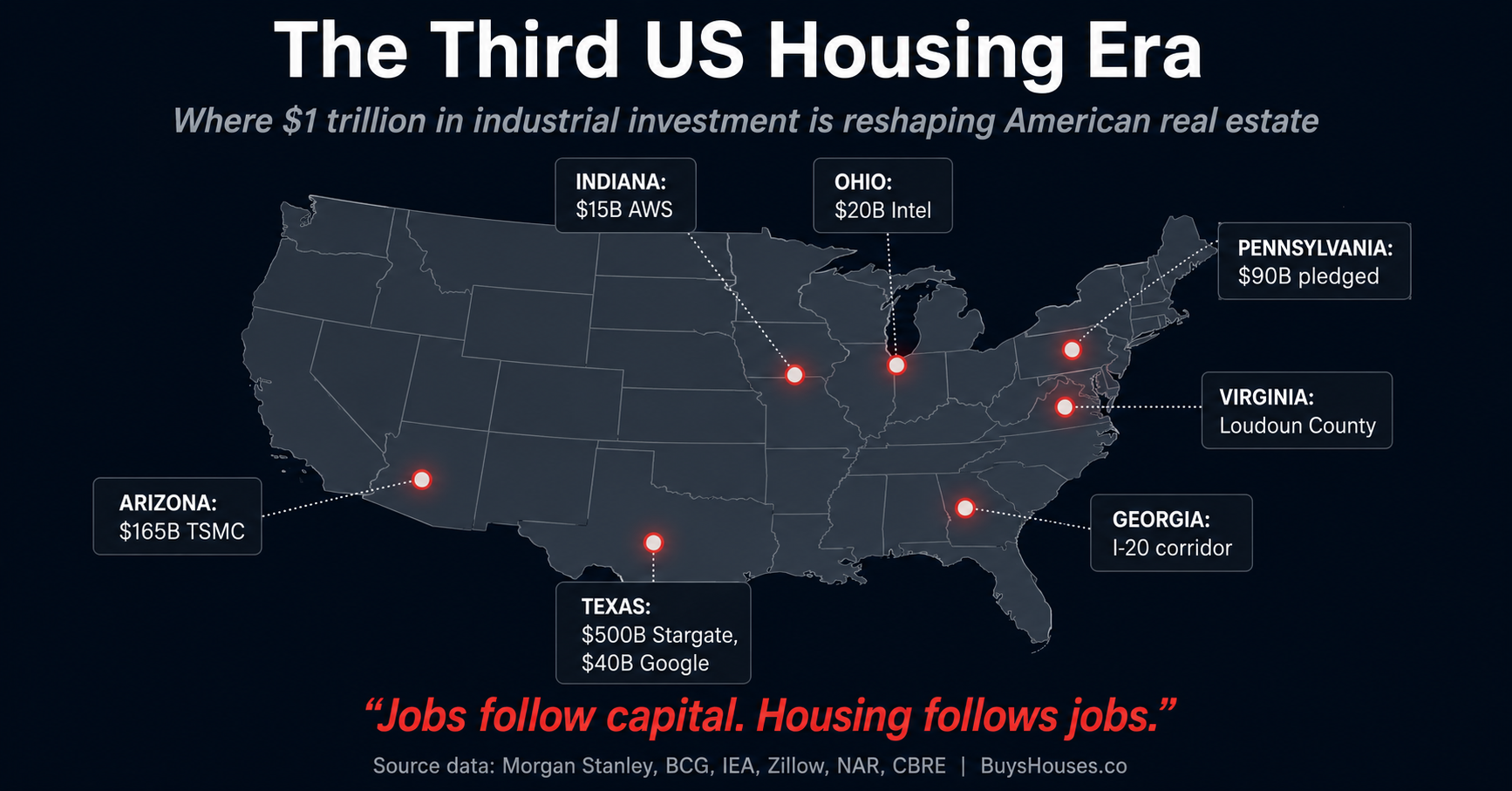
The third US housing era: $1 trillion in industrial investment across seven host states is reshaping the American real estate map.

Announced US industrial investment by state through the late 2020s, with Texas leading at $565 billion followed by Arizona, Pennsylvania, Ohio, and Indiana.
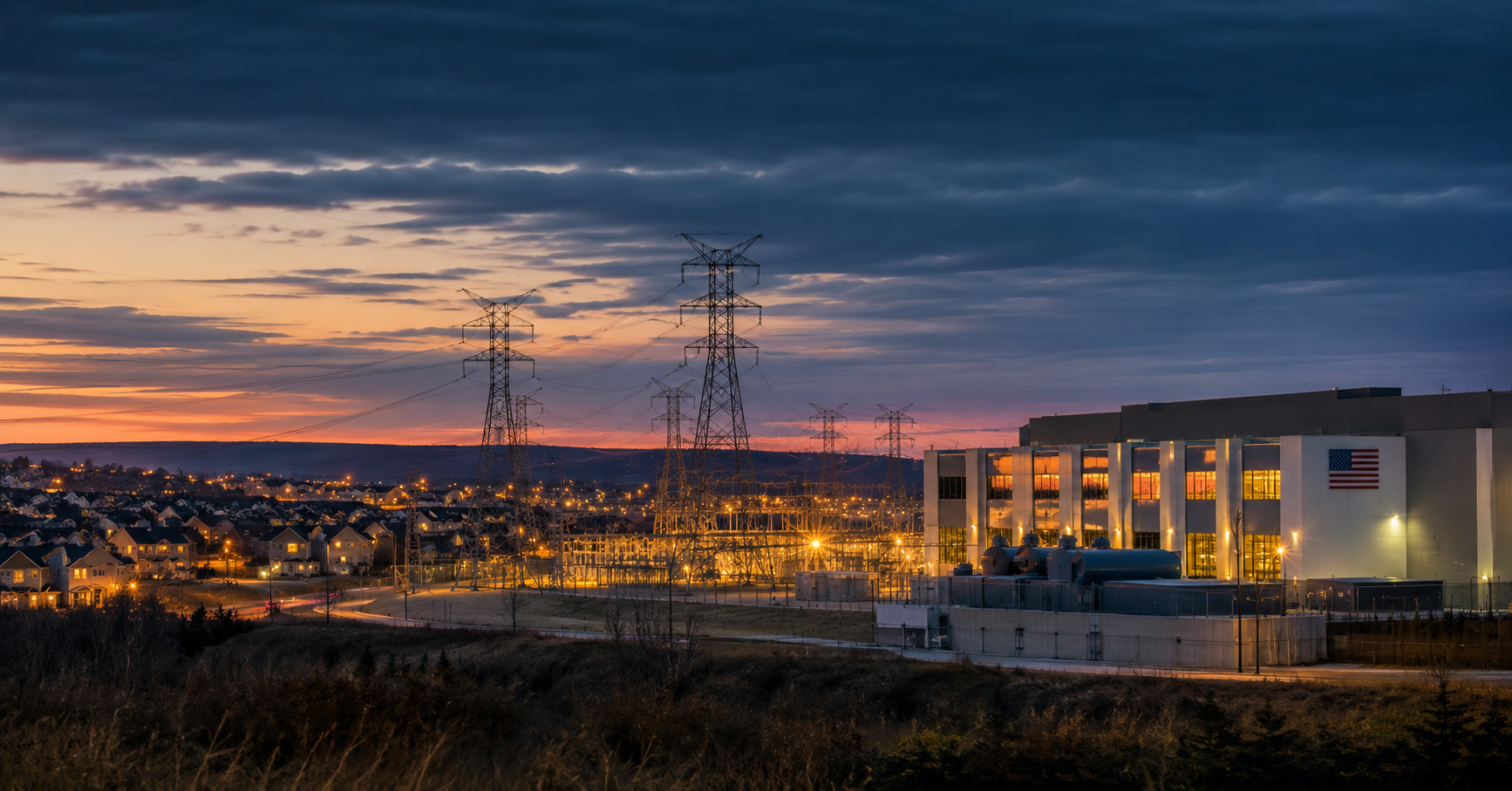
Modern American industrial infrastructure is reshaping the US housing map as data centers, semiconductor plants, and grid expansion drive a new era of regional economic growth.
Semiconductor plants, AI data centers, and energy investment are driving the third major shift in American housing geography since World War II.
Two Housing Eras Before This One
The first era ran from roughly 1945 to 1975. Steel, automotive, and heavy manufacturing made Pittsburgh, Cleveland, Detroit, Buffalo, and Chicago the engines of American housing wealth. Aerospace, defense, and oil extended the pattern into Los Angeles, Seattle, and Houston.
The second era ran from about 1975 to 2020. Personal computing, the internet, mobile devices, cloud platforms, and enterprise software reshaped the economy. Apple, Microsoft, IBM, Google, Amazon, and Meta drove decades of automation and built the largest companies in the world. Silicon Valley emerged as a global tech capital. At the same time, retirement migration, lower-cost living, and abundant land moved population south and west. San Francisco, New York, Phoenix, Atlanta, Houston, Dallas, Nashville, Charlotte, Austin, and Raleigh-Durham all led national housing price gains as tech, finance, and Sunbelt migration drove demand.
A third era is now beginning. The drivers look different, but the pattern is familiar. Jobs follow capital, and housing follows jobs.
The Squeeze Speeding Things Up
The April 2026 Consumer Price Index showed inflation at 3.8%, the highest since 2023, with energy up 17.9% and gasoline up 28.4%. Wages fell behind inflation for the first time in three years. Fannie Mae projects 30-year mortgage rates between 6.1% and 6.3% through 2027. Cotality reports the average homeowner faces about $175 more per month in escrow shortages this year from rising insurance and property tax costs.
Many Sun Belt markets experienced sharp post-COVID booms as remote work and migration pushed prices past local wage support. Florida has been hit hardest as climbing insurance premiums and tax reassessments compound the strain. Zillow reports 24 of the 50 largest US metros lost value in 2025. Austin and Tampa each dropped 6.1%, Miami fell 4.8%, and Florida statewide values declined 4.2% year over year through March 2026.
The Trillion-Dollar Buildout
Morgan Stanley projects more than $1 trillion in US data center investment through 2028. Boston Consulting Group estimates AI data centers alone will consume electricity equal to two-thirds of all current US households by 2030. The International Energy Agency reports AI server power use grew 11 times between 2020 and 2025.
Layered on top are CHIPS Act semiconductor plants, EV battery factories, expanded grid generation, and broad manufacturing reshoring. National security concerns about supply chain dependence on China, defense industrial base rebuilding, critical minerals and pharmaceutical reshoring, and robotics manufacturing all add to the cycle. Apple announced $500 billion in US manufacturing investment over four years in February 2025. Once billions commit to a multi-year project, that capital cannot easily move.
Finance is shifting in parallel. Major banks and asset managers have expanded into Dallas, Miami, Charlotte, Nashville, and Salt Lake City over the past five years. Citadel relocated its headquarters from Chicago to Miami in 2022. Goldman Sachs operates its second-largest US office in Dallas. Charles Schwab, JPMorgan, and Fidelity have grown across Texas, Florida, and the Southeast. Remote work made the expansion possible. Operating costs and tax structures shaped the destinations.
The Emerging Map
Host metros do not share a region, climate, or political profile. They share industrial geography.
Texas has moved fastest. Google committed $40 billion to two data center campuses in November 2025. OpenAI, Oracle, and SoftBank launched Stargate, a $500 billion AI infrastructure program, with its flagship in Abilene. Vantage Data Centers is building a $25 billion, 1.4 gigawatt campus in Shackelford County. Pacifico Energy permitted a 7.65 gigawatt complex in Pecos County it calls the largest US power plant. Chevron, ExxonMobil, and Diamondback Energy have announced gas-fired plants tied to AI demand. Texas data center market share rose roughly 142% from 2025 to 2026.
Other states are accelerating. Virginia remains the largest existing US data center cluster, anchored in Loudoun County. Arizona hosts TSMC's $165 billion semiconductor complex, the largest foreign direct investment in US history, alongside Intel and ASML in Phoenix and Mesa. Ohio holds about $20 billion in Intel commitments around Columbus. CBRE identifies Georgia's I-20 corridor as the next major data center development area. Indiana received a $15 billion AWS campus with 2.4 gigawatts. Pennsylvania pledged $90 billion at a July 2025 state energy summit through the late 2020s, including Amazon's $20 billion, NextEra's $17 billion Southwest Pennsylvania natural gas project, and Microsoft's deal with Constellation Energy to restart Three Mile Island.
The power supporting this buildout is overwhelmingly natural gas. Small modular nuclear reactors are in early development but not yet operational at scale, with a $40 billion Japan-US program targeting Tennessee and Alabama later in the decade.
These metros share five conditions: power capacity, water access, a skilled trades workforce, a predictable permitting environment, and a tax and business climate that supports long-term investment.
What It Means for Homeowners
National home values remain on a positive path. Zillow projects US home values up 1.2% to 2% in 2026. The National Association of Realtors forecasts about 4% growth. Most owners still hold equity built up over recent years. The structural shift operates over decades, while household financial pressure operates monthly.
About Buys Houses
Buys Houses is a Pittsburgh-based home buying company serving Western Pennsylvania. The company works with property owners facing complex situations: inherited homes, probate cases, foreclosure timelines, out-of-state heirs, properties requiring substantial repairs, and owners needing to relocate quickly. Buys Houses provides a fast cash offer for properties in any condition, manages repairs, covers closing costs, and works on a timeline set by the seller. More information is available at BuysHouses.co.
Carlo Finotti
Buys Houses
+1 412-561-9833
email us here
Visit us on social media:
LinkedIn
Instagram
Facebook
YouTube
Other
Legal Disclaimer:
EIN Presswire provides this news content "as is" without warranty of any kind. We do not accept any responsibility or liability for the accuracy, content, images, videos, licenses, completeness, legality, or reliability of the information contained in this article. If you have any complaints or copyright issues related to this article, kindly contact the author above.
